
AI Landing Zone (AILZ) - PART-1
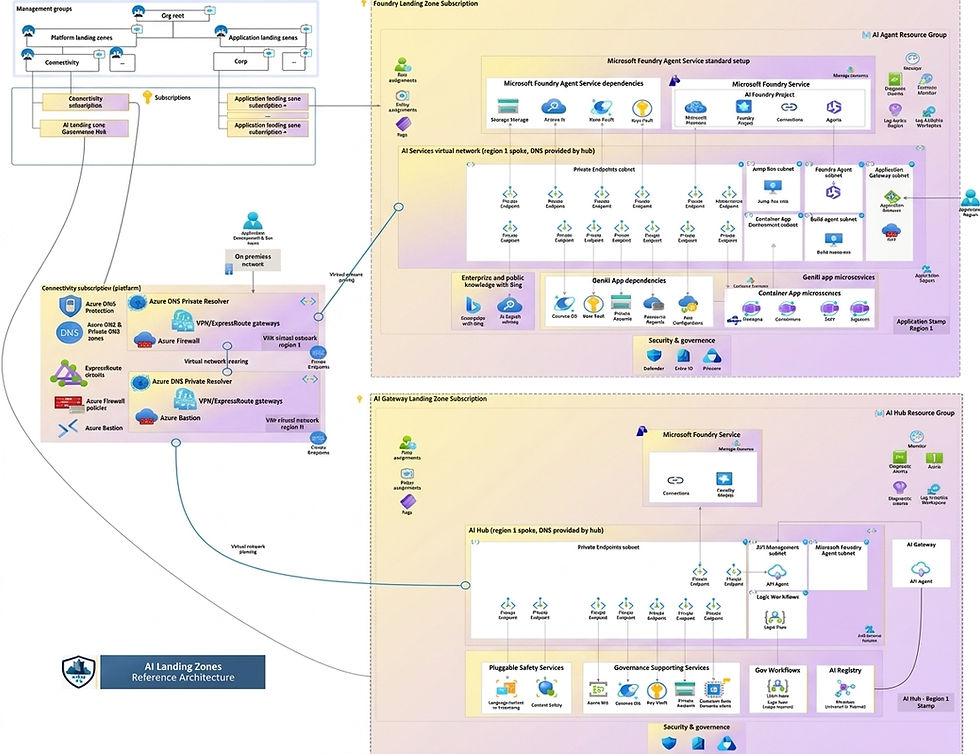
AI Landing Zone — Quick Overview
An AI Landing Zone (AILZ) is a pre‑built, secure, scalable cloud foundation designed specifically for deploying GenAI, ML, and AI workloads in a governed, enterprise‑ready environment.
Think of it as the AI equivalent of a Cloud Landing Zone — but optimized for:
Model training & inferencing
Responsible AI controls
Data governance
Security & compliance
Cost management
Operational readiness
It ensures teams can build AI solutions quickly, safely, and consistently without reinventing architecture every time.
AICAF (Azure AI Cloud Adoption Framework)
AICAF provides the strategic blueprint for adopting AI responsibly and efficiently across the enterprise. It defines governance, lifecycle, and maturity stages for AI workloads.
Key AICAF pillars integrated into AILZ:
AI Strategy & Governance: Align AI initiatives with business goals and compliance.
Responsible AI: Implement fairness, transparency, and accountability guardrails.
Operational Excellence: Standardize deployment pipelines and monitoring.
Security & Compliance: Enforce data protection and ethical model usage.
AI Lifecycle Management: Govern model creation, deployment, and retirement.

Core Components of an AI Landing Zone (Quick Overview)
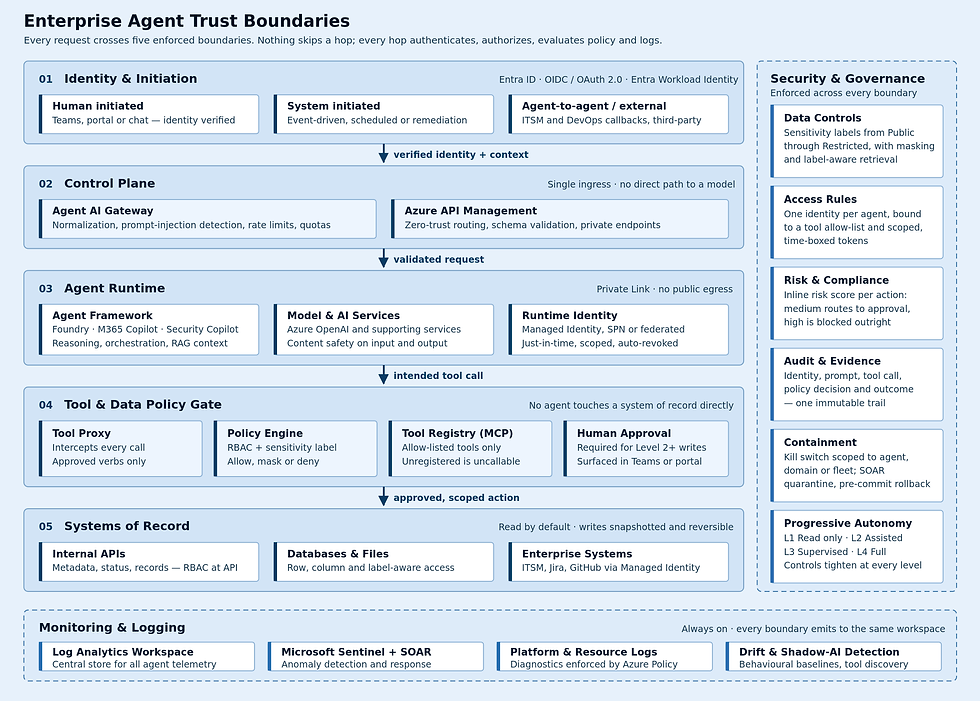
Identity & Access (IAM for AI)
Entra ID integration
Role-based access for data scientists, engineers, and business users
Managed identities for pipelines, notebooks, and AI services
Conditional access + MFA
Least privilege for model endpoints
Purpose: Secure access to data, models, compute.
Networking & Connectivity
Private endpoints for AI services
VNet integration for model inferencing
Secure connectivity to on-prem (ExpressRoute/VPN)
Network isolation for training clusters
Firewall + NSG rules for AI traffic
Purpose: Keep AI workloads private, compliant, and protected.
Data Foundation
Data Lake (ADLS Gen2)
Delta Lake / Lakehouse architecture
Data ingestion pipelines (ADF, Synapse, Fabric Data Pipelines)
Feature Store (optional)
Metadata catalog (Purview)
Purpose: Provide governed, high-quality data for AI.
AI/ML Platform
Azure Machine Learning workspace
Compute clusters (CPU/GPU)
Model registry
Prompt flow / pipelines
AutoML
Responsible AI dashboard
Model monitoring
Purpose: Standardized environment for training, tuning, and deploying models.
GenAI Services
Azure OpenAI
Model catalog (Phi, GPT, Llama, Mistral, etc.)
Vector databases (Cosmos DB, PostgreSQL, Redis)
Embeddings + RAG pipelines
Prompt orchestration
Purpose: Enable enterprise-grade GenAI development.
Security & Responsible AI
Purview policies
Data classification
Model risk assessment
Content filters
Guardrails (Azure AI Content Safety)
Key Vault for secrets
Private endpoints for LLMs
Purpose: Ensure AI is safe, compliant, and auditable.
DevOps / MLOps
CI/CD for ML pipelines
Infrastructure-as-Code (Bicep/Terraform)
GitHub Actions / Azure DevOps
Automated model deployment
Canary releases / blue-green deployments
Purpose: Operationalize AI at scale.
Monitoring & Observability
Application Insights
Log Analytics
Model drift detection
Prompt performance monitoring
Cost dashboards
Purpose: Track model health, performance, and cost.
Cost Management
Budgets & alerts
GPU quota management
Cost tagging
Chargeback/showback
Auto-shutdown policies for compute
Purpose: Prevent runaway GPU costs.
Conclusion
Building an AI Landing Zone is no longer optional for enterprises adopting GenAI and machine learning at scale — it’s the foundation that ensures every AI workload is secure, governed, and operationally ready. By aligning with AICAF and the Microsoft Well‑Architected Framework, organizations gain a structured, responsible, and cost‑efficient approach to deploying AI across the cloud. With the right identity controls, data architecture, model lifecycle governance, and network security in place, an AILZ empowers teams to innovate faster while maintaining compliance and trust. Ultimately, a well‑designed AI Landing Zone transforms AI from isolated experiments into a sustainable, enterprise‑grade capability.

awesome