
Gemini Enterprise at-a-glance
Overview
Gemini Enterprise is a secure, three-tier architecture that cleans user adoption, developer execution, and infrastructure into a structured enterprise AI Landing Zone.
Applications (Top Layer): Provides distinct front-door workspaces for employee productivity (Gemini Enterprise App), autonomous task forces (Google Antigravity), and external service (Customer Experience).
Agent Platform (Middle Layer): Acts as the mission control plane to build, scale, govern, and optimize isolated agent runtimes with strict policy guardrails and deep telemetry.
Integrated Stack (Bottom Layer): Anchors the ecosystem with high-performance compute (AI Hypercomputer), interconnected enterprise repositories (Agentic Data Cloud), and continuous perimeter security (Agentic Defense).
Architecture Design Layer Breakdown
The architecture is structured as a three-tier hierarchical stack designed to Build, Scale, Govern, and Optimize AI capabilities securely.
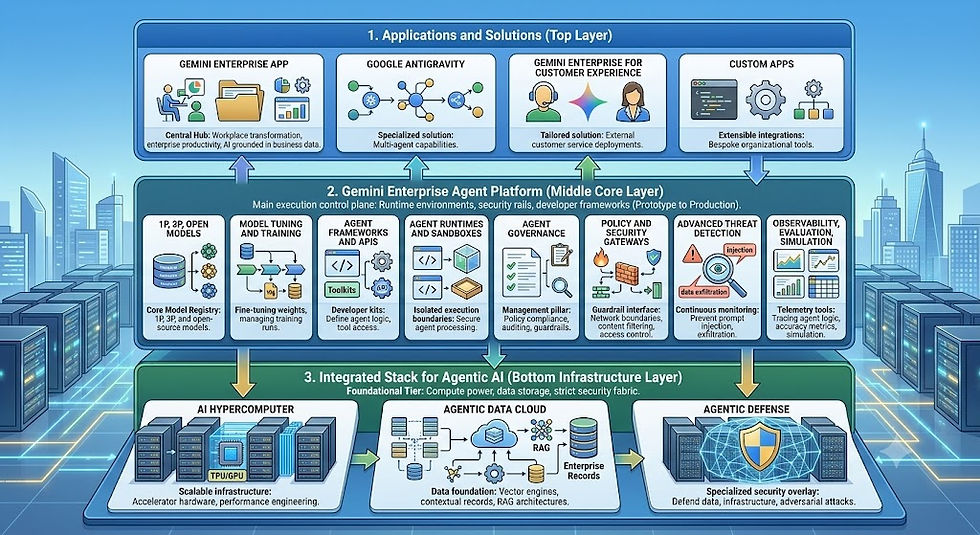
1. Applications and Solutions (Top Layer)
This is the consumption layer of the AI Landing Zone where end-users, customers, and developers interact with front-end agents and workflows.
a. Gemini Enterprise app: The central hub for workplace transformation, designed to drive
enterprise productivity with AI grounded in business data.
What it is:
The core AI productivity hub for employees — similar to Microsoft Copilot for M365.
It connects to enterprise data, identity, security, and workflows.
When to use it:
Use Gemini Enterprise App when the goal is internal productivity, knowledge access,
and employee augmentation.
Business Scenarios:
Employee productivity: drafting documents, summarizing meetings, generating reports
Knowledge retrieval: “What is our cloud migration policy?”, “Show me last quarter’s sales deck”
Enterprise search across Drive, Gmail, Docs, Sheets, Confluence, Jira
Work automation: create workflows, generate SOPs, automate repetitive tasks
Internal decision support: financial modeling, risk analysis, compliance checks
AI copilots for internal teams: HR, Finance, IT, Engineering, Operations
Use when: You want AI for employees, not customers.
b. Google Antigravity (Multi‑Agent System) :
A specialized application solution within the ecosystem for multi-agent capabilities.
What it is:
A specialized multi‑agent orchestration layer.
Think of it as AI agents that collaborate, execute tasks, and operate autonomously.
When to use it:
Use Antigravity when you need complex workflows, multi-step automation,
or AI agents working together.
Business Scenarios:
IT automation: multi-step cloud provisioning, patching, monitoring
Security operations: threat detection → triage → response → reporting
Finance workflows: invoice extraction → validation → posting → reconciliation
Supply chain automation: demand forecasting → inventory planning → vendor coordination
Customer operations: routing → classification → escalation → resolution
Multi-agent RPA replacement: agents that read, decide, act, and learn
Use when: You need AI agents performing tasks, not just answering questions.
c. Gemini Enterprise for Customer Experience:
A tailored solution layer focused on external customer service agent deployments.
What it is:
A customer-facing AI layer for contact centers, support, sales, and service.
This is NOT for employees — it’s for external customers.
When to use it:
Use Gemini CX when you want AI agents serving customers, not employees.
Business Scenarios:
Customer support bots: troubleshooting, FAQs, guided workflows
Agent assist: real-time suggestions, call summarization, sentiment analysis
Sales enablement: product recommendations, lead qualification
Service automation: appointment scheduling, ticket creation, order tracking
Omnichannel support: chat, voice, email, WhatsApp, web
Customer journey orchestration
Use when: You want AI for customers, not employees.
d. Custom apps built by you or partners:
Extensible integrations allowed within the landing zone for bespoke organizational tools.
What it is:
Your own AI apps built on Gemini APIs, Vertex AI, or Google Cloud.
These apps live inside your enterprise landing zone.
When to use it: Use custom apps when you need domain-specific, highly tailored, or proprietary solutions.
Business Scenarios:
AI for regulated industries: banking, insurance, healthcare
Custom copilots: Cloud Architect Copilot, Cybersecurity Copilot, RERA Legal Copilot
Vertical-specific apps: retail inventory AI, manufacturing quality AI
Internal portals: employee onboarding AI, policy compliance AI
Custom multi-agent systems: built on Antigravity + Vertex AI
Integration with legacy systems: SAP, Oracle, Workday, ServiceNow
Use when: You need custom logic, custom data, custom workflows, or industry-specific compliance.
2. Gemini Enterprise Agent Platform (Middle Core Layer)
This acts as the main execution control plane, providing the runtime environments, security rails, and developer frameworks required to transition from prototype to production.
1P, 3P, open models: The core model registry layer containing first-party, third-party, and open-source models available for orchestration.
Model tuning and training: The landing zone pipeline area for fine-tuning weights and managing training runs on corporate datasets.
Agent frameworks and APIs: The developer kits and code boundaries used to define agent logic, tool access, and API interactions.
Agent runtimes and sandboxes: The isolated execution boundaries ensuring secure code execution and processing of agent routines.
Agent governance: The management pillar that handles policy compliance, auditing, and operational guardrails across the agent mesh.
Policy and security gateways: The main guardrail interface managing network boundaries, content filtering, and direct access controls.
Advanced threat detection: Continuous monitoring tools to prevent prompt injection, data exfiltration, or rogue agent behavior.
Observability, evaluation, simulation: Telemetry tools for tracing agent logic, evaluating accuracy metrics, and simulating agent behaviors before production deployment.
3. Integrated Stack for Agentic AI (Bottom Infrastructure Layer)
The foundational infrastructure tier provides the compute power, data storage, and strict security fabric that anchors the entire AI Landing Zone.
AI Hypercomputer: The scalable underlying infrastructure providing optimal accelerator hardware (TPUs/GPUs) and performance engineering.
Agentic Data Cloud: The data foundation that feeds vector engines, contextual enterprise records, and RAG architectures directly to the agents.
Agentic Defense: The specialized enterprise-grade security overlay guarding the structural integrity of data and infrastructure against evolving adversarial attacks
Conclusion
Gemini Enterprise is a secure, three-tier architecture that cleans user adoption, developer execution, and infrastructure into a structured enterprise AI Landing Zone.
Applications (Top Layer): Provides distinct front-door workspaces for employee productivity (Gemini Enterprise App), autonomous task forces (Google Antigravity), and external service (Customer Experience).
Agent Platform (Middle Layer): Acts as the mission control plane to build, scale, govern, and optimize isolated agent runtimes with strict policy guardrails and deep telemetry.
Integrated Stack (Bottom Layer): Anchors the ecosystem with high-performance compute (AI Hypercomputer), interconnected enterprise repositories (Agentic Data Cloud), and continuous perimeter security (Agentic Defense).

Comments